
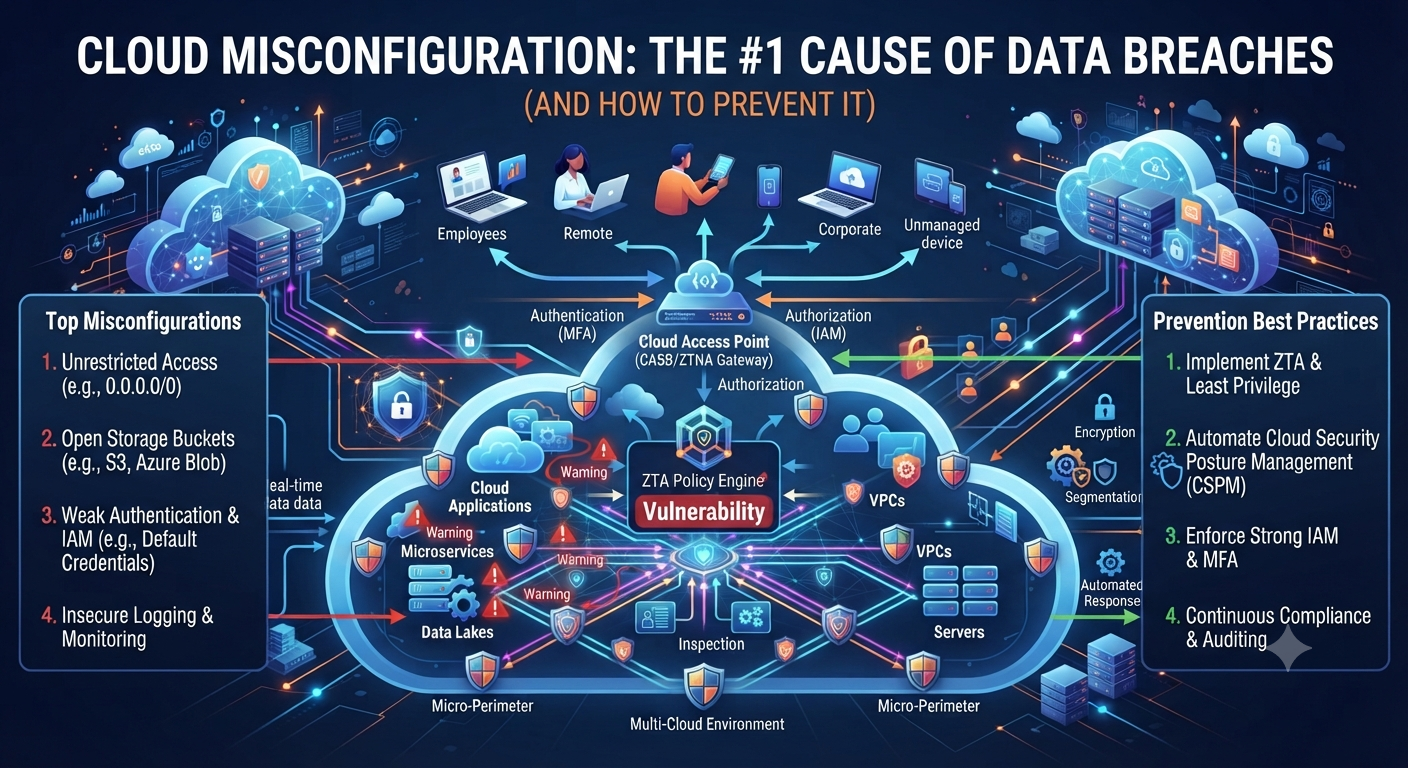
Cloud Misconfiguration: The #1 Cause of Data Breaches (and How to Stop It)

Ask any security researcher what causes most cloud data breaches and you’ll get the same answer over and over: it’s rarely a genius hacker breaking through advanced defenses. It’s cloud misconfiguration. An open storage bucket. A firewall rule that was never hardened. An unclosed firewall rule.
This one mistake is quiet, unglamorous and completely avoidable. Which is exactly why it’s the leading cause of breaches, year after year. In this guide we’ll dissect what this problem actually looks like, why it continues to happen even at well-funded companies, and the specific steps you can take to prevent it before it costs you.
What Is Cloud Misconfiguration?
Cloud misconfiguration occurs when cloud resources—such as storage buckets, databases, servers, or network settings—are incorrectly configured, exposing them to unauthorized access. The cloud provider’s software is not broken. It’s a mistake in how the person or team has set up their own environment.
Think of it this way: you leave your front door open. AWS, Azure and Google Cloud all offer good security tools, but those tools are only effective if configured correctly. This is the sort of gap that can emerge when that configuration step is missed, hurried, or just plain incorrect.
Why Cloud Misconfigurations Are the #1 Cause of Data Breaches

It’s tempting to think that breaches happen as a result of sophisticated attacks. The truth is really a lot more simple and, frankly, a little maddening. This is why it keeps topping the list:
- Cloud environments are always changing. Teams move quickly, new services are created, and permissions are tweaked. Speed will often outrun careful review.
- The default settings are not necessarily secure. A lot of cloud services are not secure by default, and if you don’t lock them down, they remain open.
- People get confused about shared responsibility. Cloud providers can secure the infrastructure but customers have to secure what they put in it. This gap is always misunderstood.
- Multi-cloud makes it worse. It is really hard to keep the same security settings across AWS, Azure and Google Cloud at the same time and small gaps get through.
- You will make a mistake. Even experienced engineers make mistakes, especially when facing deadlines and forgetting checklists.
None of these reasons is exotic. That’s the whole point. Cloud Misconfiguration Is Not Caused by Rare Advanced Threats. It’s the accumulation of everyday oversights.
Typical Types of Cloud Misconfiguration
Easier to catch them if you know what the most common mistakes are. Here are the ones security teams see over and over.
1. Publicly Exposed Storage Containers
That’s the classic example of a security gap in the cloud. A storage bucket, such as an AWS S3 bucket, is marked “public” instead of “private” and suddenly anyone with the link can view or download sensitive files.
2. Excessively Permissive Access Controls
One of the most common types of cloud misconfiguration is giving broad permissions “just to be safe.” If users or applications are given far more access than they need, a single compromised account can lead to the exposure of huge amounts of data.
3. Systems that are not patched or are out of date
A great entry point is running outdated software or dependencies within cloud environments. This is the kind of oversight that often goes unnoticed because nothing appears “broken” on the surface.
4. Logging and Monitoring Disabled
If logging is off or misconfigured, a breach could go undetected for weeks or months. This mistake isn’t going to directly cause a breach, but it sure makes recovery a whole lot harder.
5. Default or weak credentials
One surprisingly common issue is leaving default passwords or API keys unchanged, especially in fast-paced development environments where security is an afterthought.
6. Network settings misconfigured
Open ports, missing firewall rules, and overly permissive inbound traffic configuration can all be network configuration errors. These are often the easiest to discover for attackers using automated scanning tools.
The Hidden Cost of Cloud Misconfiguration
The fallout from this kind of exposure extends far beyond one leaked file. Depending on how bad it is, it can lead to:
- Theft of customer data and legal consequences
- Regulatory fines under laws such as GDPR or HIPAA
- Reputational damage, which can take years to recover from
- Direct financial loss due to exposure to fraud or ransomware
- The loss of customer trust – one of the hardest things to get back
That’s why prevention is so much more important than damage control. Once sensitive data is out there you can’t unsend it.
How to Avoid Cloud Misconfiguration: One Step at a Time
The good news is that cloud misconfiguration is among the most preventable security risks out there. Here’s a practical roadmap.
Step 1: Complete a Full Cloud Asset Inventory
What does not know you exist can’t be secured. Begin by inventorying all the cloud resources, storage buckets, databases, and services your organization uses across all providers.
Step 2: Implement the Principle of Least Privilege
Review all user, application and service accounts and remove access they don’t strictly need. This one step removes a huge amount of possible exposure.
Step 3: Enable encryption everywhere
Default to encrypting data at rest and in transit. Encryption is a key layer of protection, even in case of data exposure due to misconfiguration.
Step 4. Automate configuration checks
Manual reviews can’t keep up with the speed of change in cloud environments. Use cloud security posture management (CSPM) tools to scan for misconfigurations automatically and flag them in real-time.
Step 5: Turn on logging and ongoing monitoring
It’s recommended to enable logging for all services and configure notifications for anomalous activity. Early detection can mean the difference between a minor incident or a full-blown breach.
Step 6: Standardize Configuration with Templates
Use infrastructure-as-code tools to provision resources with approved, secure configurations each time, instead of manual, person-to-person configuration.
Step 7: Conduct Regular Security Audits
Review your cloud environment on a regular basis – not once a year, but continuously. Cloud environments are always changing and your audits need to keep pace.
Step 8: Training Your Team
Many of these situations are not about a lack of skill but about a lack of awareness. Ongoing training helps ensure security is top of mind for everyone touching your cloud infrastructure.
Avoid Cloud Misconfiguration Manual versus Automated Approach
| Factor | Manual Review | Automated (CSPM) |
|---|---|---|
| Speed | Slow, intermittent | Continuous, real-time |
| Scalability | Scaling problems | Cloud usage based pricing |
| Risk of error | Higher | Significantly lower |
| Cost | Less upfront | More upfront, saves in the long run |
| Best for | Small, non-dynamic env. | Multi-cloud, fast-changing env. |
Best Tools to Detect and Prevent Cloud Misconfigurations
There are several categories of tools that can help prevent these errors from becoming a breach:
- CSPM (Cloud Security Posture Management) tools continuously monitor your cloud accounts for misconfigurations.
- CNAPP (Cloud-Native Application Protection Platform) is a single place for posture management and workload protection.
- IAM auditing tools help identify permissions that are too broad before they become an issue.
- Infrastructure-as-code scanners detect misconfigurations before deployment, not after deployment.
Most medium and large organizations end up using a combination of these rather than just one.
FAQs (Frequently Asked Questions)
What is the most common misconfiguration in the cloud?
A common example is a publicly accessible storage bucket, like an AWS S3 bucket that is set to public when it should be private. This one mistake has been responsible for some of the biggest data leaks in recent years.
Can we completely avoid this kind of security gap?
Human error will always be a factor and cannot be eliminated, but it can be dramatically reduced through automation, least privilege access and regular audits. “If you have the right processes in place, most incidents are preventable.”
Cloud misconfiguration: Who is to blame, the provider or the customer?
In the shared responsibility model, cloud providers are responsible for the security of the underlying infrastructure, and customers are responsible for the security of what they configure and store within it. This means that the customer is almost always responsible for closing these gaps.
Will these security holes be discovered soon?
With the right CSPM tools and continuous monitoring, misconfigurations can often be detected within minutes of their occurrence. Without these tools detection can take weeks or months.
Is cloud misconfiguration a problem only for big companies?
No. Small and mid-sized businesses are often targeted precisely because they tend to have fewer resources dedicated to catching these errors before attackers find them.
Want to learn how to catch these errors before the attackers do?
Knowing how to read this problem on paper is a good start but knowing how to find and fix these gaps in a live AWS or Azure environment is what separates a resume from a career. Pentest Craft offers Cloud Computing courses in AWS Certified Solutions Architect and Microsoft Azure that will teach you how to securely deploy cloud resources from scratch.
To think like the attackers who exploit these kinds of gaps, our Penetration Testing and CEH (Certified Ethical Hacking) courses teach you to find exposed storage buckets, weak permissions, and open ports before they make headlines. And if you’re interested in a governance or leadership role, our CISSP course covers the risk management frameworks that hold organizations accountable.
Whether you’re just starting your cybersecurity career or taking your cloud skills to the next level, start learning the practical side of cloud security today—browse our full course catalog.
Final Thoughts
The problem is that cloud misconfiguration is not an exciting topic to discuss. It doesn’t get the flashy zero-day exploits that get all the attention, but it remains the leading cause of cloud data breaches year after year. The fix is not more complex technology. It’s disciplined, consistent processes: least privilege access, continuous monitoring and automated checks that catch mistakes before they become headlines.
If you get the basics right you eliminate the vast majority of risk before it has the chance to become a breach.
Interested in hands-on training on securing real cloud environments? Sign up for a Pentest Craft course today and start fixing these gaps yourself.
1 Comment
A WordPress Commenter
April 13, 2026Hi, this is a comment.
To get started with moderating, editing, and deleting comments, please visit the Comments screen in the dashboard.
Commenter avatars come from Gravatar.