
The Definitive Guide to Implementing Zero Trust Architecture for Cloud Security
If you’ve done any research into cloud security lately, you’ve probably seen the term Zero Trust Architecture more times than you can count. This is not just a buzzword for security vendors to sell a product. With everything moving to the cloud, it’s becoming standard practice for how companies protect their customers, applications and data.
In this guide we will look at what Zero Trust Architecture in cloud security really means, why the old way of cloud security is not working anymore, and how you can implement this zero trust security model step-by-step in your own organization. No BS, no fluff. A clear, practical road map.
What is Zero Trust Architecture?
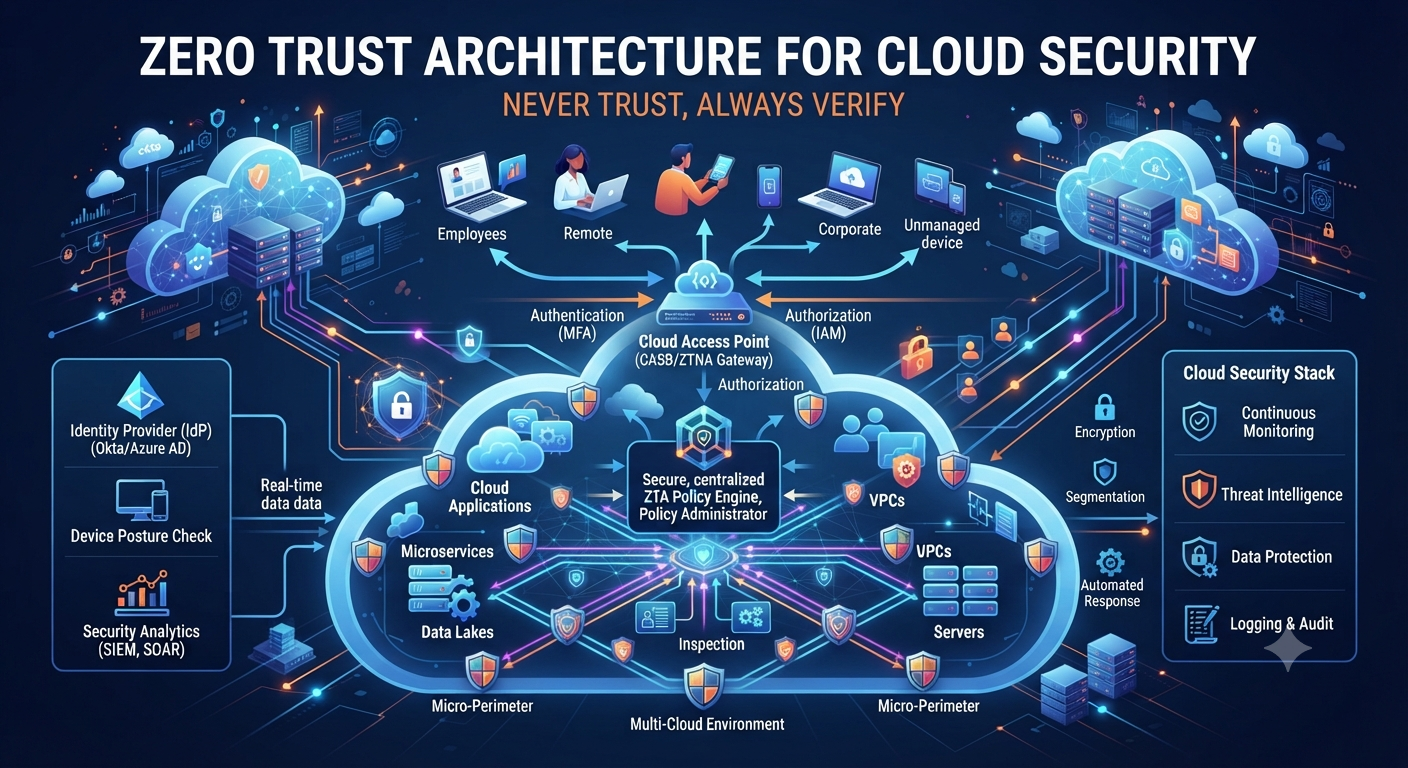
A Zero Trust Architecture is a security model based on one simple principle: never trust, always verify. This identity-first model assumes that no one in your network is safe – every user, device and application is a potential threat until it proves otherwise.
Traditional security was a castle and a moat. Once inside the walls, you were trusted. This model takes the moat out. All access requests, whether they originate from an employee’s laptop, a contractor’s phone, or an automated script, must be validated before being granted.
This is even more important in cloud environments where there is no real perimeter anymore. Your data might be in AWS, your apps in Azure and your team logging in from five different countries. Zero Trust Architecture was built for this distributed, cloud-first world.
Cloud Security Models Are Failing
Old-school security was based on a clear inside-outside network demarcation. That assumption just isn’t true anymore. Here’s why:
- The perimeter was broken by remote work. Employees log on from airports, coffee shops and home networks. No wall to protect.
- Multi-cloud is the new standard. Most companies use more than one cloud provider, so data is in multiple places with different security settings.
- Machine identities have exploded. In fact, most organizations have more service accounts, APIs and AI agents than they have actual human users and each is a potential entry point.
- The most common attack method is credential theft. Once inside, no one double checks them. Attackers walk through perimeter defenses with stolen passwords and session tokens.
That’s precisely the gap Zero Trust Architecture was designed to fill. It never trusts anything by default and always verifies identity instead of trust based on a location or network.
Core Principles of Zero Trust Architecture (ZTA)
A solid zero trust framework rests on a few core principles. Knowing these will help you make smarter decisions when you start to implement it.
1. Check explicitly
Every access request must be authenticated and authorized using all available data points, such as user identity, device health, location, and behavior patterns. Just because someone successfully logged in last week does not mean they have a free pass.
2. Least Privilege Access
Users and applications should be given only the minimum access required to do their job and nothing more. If a marketing person doesn’t need access to financial databases, they shouldn’t have it. Period.
3. Assume a breach
This is the mindset shift that makes Zero Trust Architecture so powerful. Your plan is to assume the attacker is already inside, not to hope your defenses work. That means segmenting networks, encrypting data and continuously monitoring for anomalous activity.
4. Micro Segmentation
This is in contrast to one large network where one breach in a location compromises everything. This approach slices the environment into small isolated zones. Damage is still limited if only one segment is compromised.
5. Ongoing Monitoring
Access is never a one time check. It monitors sessions live and can immediately revoke access if it sees anything dodgy, like a login from an odd place.
Deploying Zero Trust Architecture in the Cloud: Step by Step
Trying to implement a zero trust security model all in one go can be overwhelming. Don’t do it all at once, do it in manageable bits.
Step 1: Map Your Assets and Data Flows
You need to know what you actually have before you can protect anything. Identify your cloud applications, sensitive data repositories, and the flow of information between them. If you can’t see it, you can’t get it.
Step 2: Enforce Strong Identity Verification
Zero Trust Architecture is built on identity. Begin with:
- Multi-factor authentication (MFA) for all users, no exceptions
- Single sign-on (SSO) for centralized identity management
- Conditional access policies based on location and device health
Step 3: Enforce least privilege access controls
Audit each user, group and service account and remove unneeded permissions. That one step knocks out a big chunk of your attack surface.
Step 4: Divide Your Network
Micro-segmentation to divide your cloud environment into smaller zones. Keep sensitive workloads away from general traffic, so a breach in one area cannot roam free.
Step 5: Encrypt Data Everywhere
Encrypt data at rest and in transit. And even if an attacker finds a way around your other defenses, encrypted data is much harder to do anything with.
Step 6: Conduct Ongoing Monitoring & Analytics
Use tools that monitor user behavior and automatically highlight anomalies. Here, AI-driven monitoring has been especially useful, spotting suspicious patterns faster than ever could be done by manual review.
Step 7: Automate response and remediation
If something seems wrong, waiting for a human to notice is a waste of precious time. If a threat is detected, automated response systems can lock out accounts, quarantine devices or revoke access.
Step 8: Review and Polish Often
This is not a “set it and forget it” project. Your business changes, threats evolve, and your policies must be reviewed regularly to be effective.
Traditional Security and Zero Trust: Major Variations
| Factor | Traditional Security | Zero Trust Architecture |
|---|---|---|
| Trust model | Trust in the network | Do not trust anybody by default |
| Access control | Broad, network-wide | Granular, based on identity |
| Perimeter | Defined network boundary | Fixed no perimeter |
| Monitoring | Constant monitoring | Continuous verification |
| Breach containment | Often spreads through network | Compartmentalized containment |
Common Difficulties in Implementing Zero Trust Architecture
Nothing so valuable comes without a few obstacles. Here’s what most teams go through:
- Old systems. Integrating older applications can be tricky because they weren’t built with identity-based access in mind.
- User resistance. The added checks can be frustrating for workers who are accustomed to fast, frictionless access. A lot helps when you communicate clearly why it matters.
- Cost and complexity. Full implementation requires time, budget and the right tools. Most companies deploy it in stages, not all at once.
- Skills gaps. Identity-first tools are a different mindset from traditional network security and security teams need training to properly manage them.
These hurdles are not show stoppers. They just mean to take your time with the rollout, not rush it.
Best Practices for a Successful Zero Trust Implementation
- Start with your highest risk assets rather than everything at once.
- Get IT, security and leadership involved from day 1 so no one is caught off guard.
- Choose cloud-native tools that plug directly into your current providers.
- Define clear metrics so you can measure if your zero trust strategy is actually reducing risk.
- Notify staff of changes to avoid miscommunications or opposition.
FAQ (Frequently Asked Questions)
What is the primary objective of Zero Trust Architecture?
The main goal is to get rid of automatic trust. Every user and device must be authenticated at all times whether inside or outside of the network which greatly reduces the risk of a breach spreading.
Does Zero Trust Security Only Work for Big Companies?
No. Big companies were the first to do this, but smaller companies and mid-sized companies can get similar benefits, especially since cloud tools have made identity-based security cheaper and easier to set up.
It takes time to get Zero Trust Architecture up and running.
It depends on how big your organization is, but most companies take anywhere from six months to two years to do a full rollout. Many start with a phased approach, starting with the highest-risk areas.
Does this security model replace firewalls and antivirus?
Nope. It’s built to work with your existing tools, not replace them. Think of it as an additional layer that’s more about identity and access than network defense.
VPN vs. Zero Trust: What is the difference?
Once a user logs into a VPN, they are given broad network access, similar to the old castle-and-moat approach. Zero Trust Architecture on the other hand validates each and every request individually and is far more secure for cloud environments.
Want To Develop These Skills For Yourself?
To read of this model is one thing. But how to design, deploy and manage it in a real AWS or Azure environment is another story. Our Cloud Computing courses at Pentest Craft, like AWS Certified Solutions Architect and Microsoft Azure, will guide you through identity-based access controls, network segmentation and secure cloud configuration, practically and not just theoretically.
And if you want to dig into the security side more, our CISSP course talks about the governance and risk frameworks behind Zero Trust adoption, and our Penetration Testing course teaches you how attackers actually try to circumvent these defenses, so you know exactly what you’re protecting against.
If you’re an IT pro looking to specialize in cloud security, or a business owner who wants your team trained properly, check out our full course catalog and start building practical, job-ready skills.
Closing Thoughts
Zero Trust Architecture is not a trend that will go away next year. It’s a direct answer to how business is actually getting done today: with distributed teams, multiple cloud providers, and an explosion of machine identities that traditional security was never intended to handle. Organisations that start to adopt it now, even in stages, will be in a much better position when the next big breach attempt comes knocking.
Start small and focus on identity first and build from there. It’s less about buying one product and more about changing the mindset of your whole organization around trust.
Ready to learn how to build one for real? Sign up for a Pentest Craft course today and turn this guide into real, hands-on expertise.