
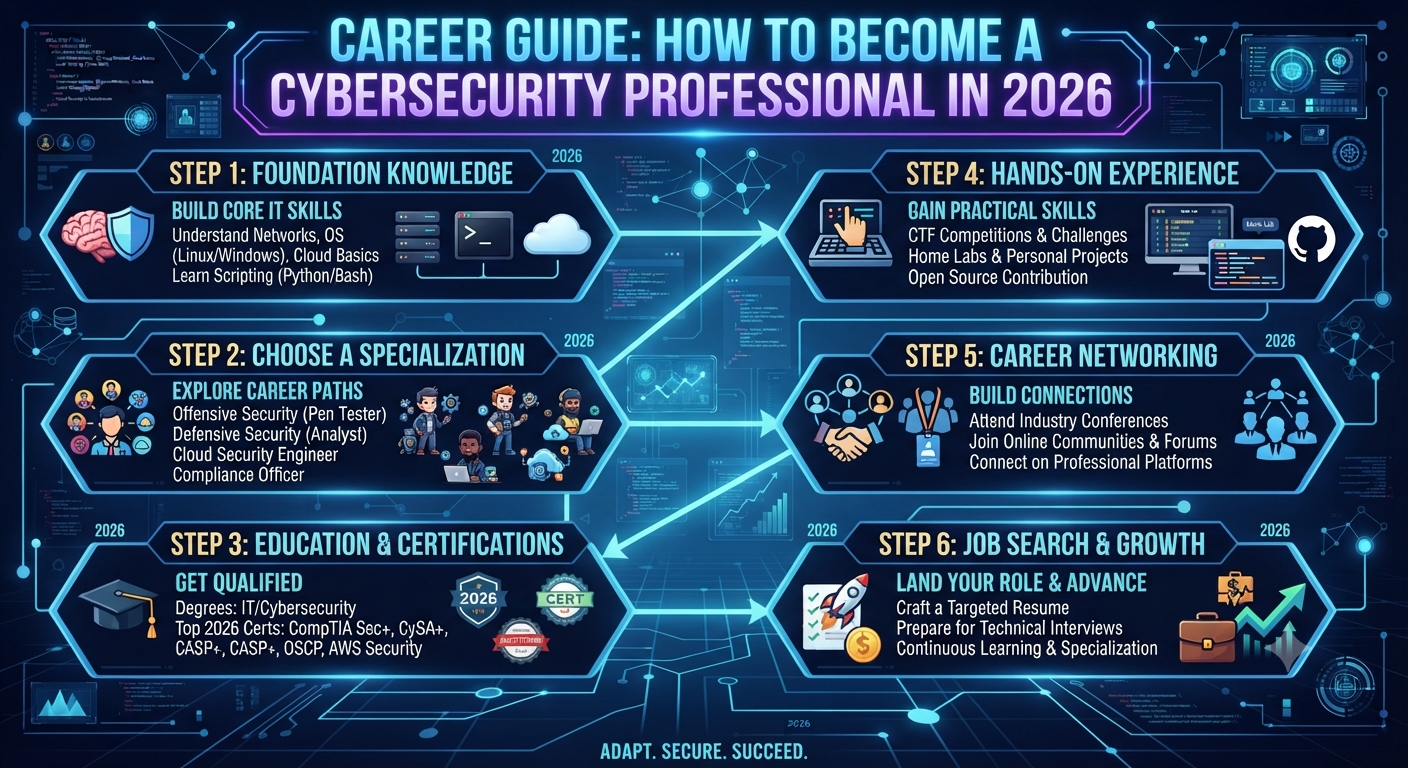
How to Become a Cyber Security Professional in 2026

Introduction Cybersecurity is one of the fastest growing technology industries and one of the most resilient given the world’s reliance on digital infrastructure As we approach 2026, the emergence of new technologies at a rapid pace, the increasing number of cyberattacks, and the changing nature of threats all contribute to a need for a skilled cybersecurity workforce. If you’re a student or an IT professional looking for new challenges or someone interested in a career change, a career in cybersecurity is a path of stability, opportunity and the satisfaction of protecting what matters most.This resource provides a complete overview of the strategies, skills and procedures needed to create and achieve success in a cybersecurity career. It provides a thorough overview of current trends, practical advice and tangible actions.
Why is cyber security important? Organizations worldwide are facing a new level of cyber risk due to ransomware, phishing, and data breaches. This has resulted in a serious shortage of cyber security professionals. Industry estimates suggest millions of new cybersecurity jobs will need to be filled in the next several years. Top reasons to build a career in cybersecurity: Why: Cybersecurity threats are a persistent issue across all sectors and job security is a major concern. We will pay you a competitive salary and offer you attractive benefits in return for your professional skills. Career growth: There’s a very clear path from analyst to CISO in this field. Objective You’re at the forefront of safeguarding data, privacy and digital trust.
Step 1: Getting to Know the Cyber Security Terrain Cyber security is a multi-dimensional topic. It’s useful to know what kind of roles are out there before you begin: Security Analyst Builds defenses, investigates incidents, maintains systems. Ethical Hacker (Penetration Tester) – Be a hacker, locate vulnerabilities before they are. Security Engineer – Designs & develops secure security systems. Incident Responder – Deals with and handles security incidents and cyber security emergencies. Security Consultant: Provides advice to organizations on compliance, risk management, and best practices. At the executive level, the CISO owns the security strategy. Different roles require different mixes of technical skills, analytical skills, and communication skills.
Step 2: Create a Strong Foundation. “To succeed in the field of cybersecurity, one needs a good understanding of information technology. Specialties Networking – Knowledge of network architectures, protocols, firewalls and VPNs . Get to know the Linux and Windows operating systems. Programing: Not always needed, but learning a programing language, like Python or Bash, can be very useful for the automation and scripting of tasks. Security Fundamentals : Learn about encryption , authentication , access controls , and threat modeling . You can learn these skills at your own pace using open source labs, MOOCs and free online resources.

Step 3: Choose a RouteThere’s no one-size-fits-all approach to getting a cybersecurity career. The typical paths are following: Earn a related degree, such as information security or computer science. Self-Paced: Cybersecurity forums, blogs, YouTube tutorials, and courses. Bootcamps are immersive, hands-on programs that get you ready for a career in months, not years. Certification Industry recognized certifications are a sign of your abilities and can help you move forward (see list below). Many successful professionals use several of these methodologies and continue to learn and grow as technology progresses.
Step 4: Get Certified One way to prove your skills and boost your credibility with potential employers is to get certified. These certificates are highly regarded by both beginners and seasoned professionals: CompTIA Security+ is an entry-level security certification. This is security 101. Certified Ethical Hacker (CEH) : Focuses on hacking techniques and penetration testing. Certified Information Systems Security Professional (CISSP) – This is best for professionals with considerable experience in security project management. Certified Cloud Security Professional (CCSP) and Certified Information Security Manager (CISM) Cloud security and management. Get certifications relevant to your career path and the jobs you want.
- Grab it. Employers want real skills, relevant skills, not pieces of paper. So here are some suggestions for practical experience: Home Labs Build virtual machines to test tools and simulate attacks in a safe setting Open Source Projects – Contribute to community and security tools. Security issues – participate in hackathons and CTFs (Capture The Flag). Internships: Seek out entry-level jobs or internships to help you build your professional network and resume. Volunteer. Work for a struggling small business or a non-profit that can’t afford to pay you.
Step 6: Build Your Professional Network Cybersecurity is a very collaborative field. Networking is a great way to learn about job opportunities, emerging threats and technologies, and find mentors. LinkedIn – Join cybersecurity groups, network with cybersecurity professionals, and follow key people in the field. Attend conferences, meetups, virtual events, and local industry events. Online Communities: Join specific Slack channels, Discord servers and Reddit forums revolving around Cybersecurity. Never can the importance of a good network in one’s professional life be overstated.
Step 7: Work on Your Soft Skills Technical skills are important, but the best cybersecurity professionals also possess strong soft skills. Communication: Explain complex concepts in an easy-to-understand way to those who aren’t technical. Being able to think creatively and problem solve is essential to anticipate and respond to potential hazards. Flexibility – Show that you can stay calm in a high pressure situation and be open to change. Morals. “You work on trust, and so you have to be held to the highest ethical standards.
- Learn, learn, learn.The world of cybersecurity is constantly evolving. What you know today may be obsolete tomorrow. Commitment to continuous learning. Subscribe to cybersecurity news and threat intelligence sources. Earn additional certifications. Take higher level classes. Explore emerging technologies such as artificial intelligence, cloud security and the Internet of Things.
Step 9: Look into Career Progression and SpecializationWith experience, you could specialize in topics like compliance, red teaming (attack), blue teaming (defense), cloud security, or digital forensics. As you develop, you might find yourself in a position to lead teams or to play a CISO role.
Step 10. Begin the application process and do well at the interview.Tailor your CV to highlight the skills, qualifications, certifications, and practical experience that are most pertinent to the position. Practice the typical technical interview questions so you can show you can solve them. Get ready for the interview. Be prepared to discuss your enthusiasm for learning, curiosity and love of learning.
