
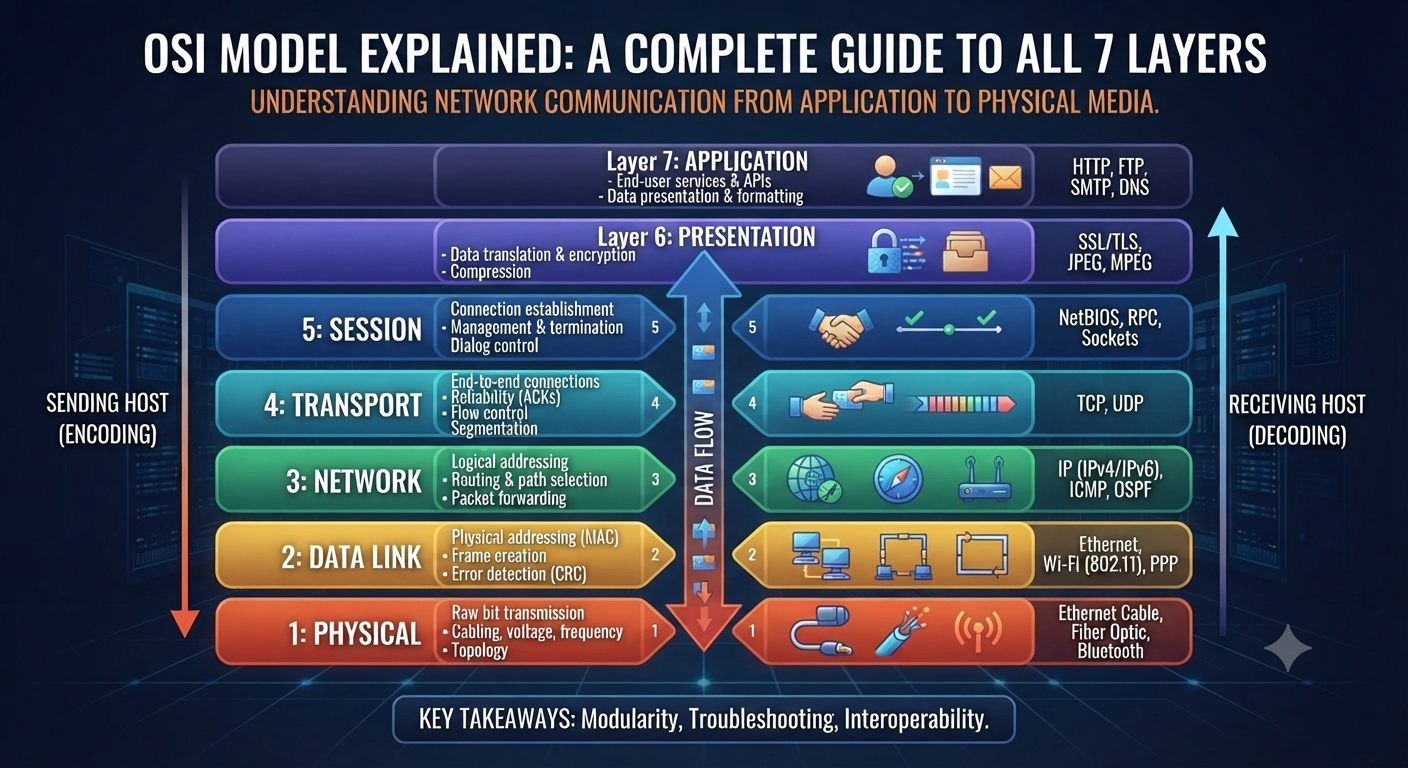
The OSI Model Explained: A Complete Guide to the 7 Layers
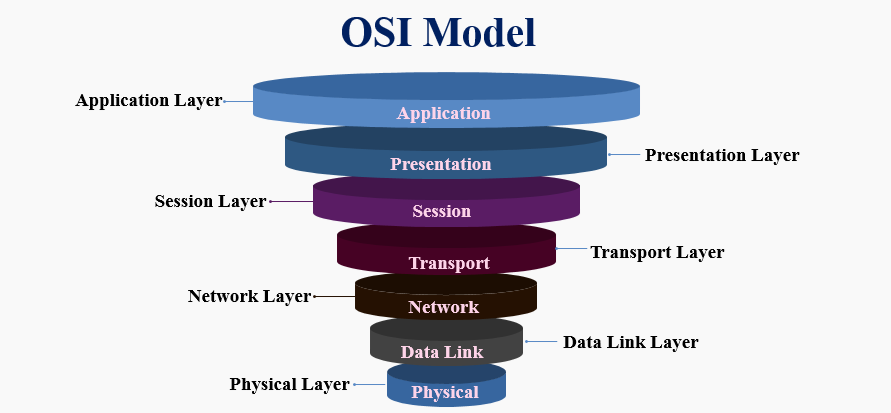
If you have started learning networking, then you would have heard about the OSI Model within the first few days. You’ll see it in every textbook, on every certification exam, and in almost every networking interview question. And with good reason: it’s the most useful mental model for understanding how data actually travels from one device to another.
In this guide we’ll walk through this framework one layer at a time, explain why it still matters even though real-world networks don’t follow it exactly, and show you how to actually remember all seven layers without just memorizing a list.
The OSI model is the Open Systems Interconnection model.
The OSI Model, which stands for Open Systems Interconnection Model, is a conceptual model that standardizes the way in which various network protocols communicate and interact with one another. It breaks the whole process of network communication into 7 different layers . Each layer has a specific job .
Think of it like a mail system . A letter passes through several stages before it arrives at its destination: it is written, put in an envelope, addressed, sorted and delivered. This is the same idea as the framework, except instead of a letter you have data moving across a network, and instead of a mail carrier each layer passes the data to the next.
The International Organization for Standardization (ISO) developed it to give network engineers a common language and standard way to design and troubleshoot systems, no matter the vendor or technology used.
Why the OSI Model Still Matters Today
Some students ask why they need to learn this framework, since real networks run on the simpler four-layer TCP/IP model. This is why it still deserves a place in every curriculum:
- It is the standard troubleshooting framework. When something goes wrong, network engineers will ask, “which layer is this happening at,” and that question alone quickly identifies the issue.
- It establishes a common language. It is this model that makes sense of terms like “Layer 2 switch” or “Layer 3 routing.” Engineers all over the world use the same reference points.
- It’s on all the major certifications. CCNA, Network+ and nearly every other entry-level IT exam tests your knowledge of it directly.
- It simplifies a very complicated thing. It’s much easier to learn than trying to understand everything at once when you break down the network communication to 7 more manageable parts.
Although real hardware and software do not break down into exactly seven discrete layers, this model is still the best teaching tool in the industry for understanding how networks work.
Understanding the 7 Layers of the OSI Model
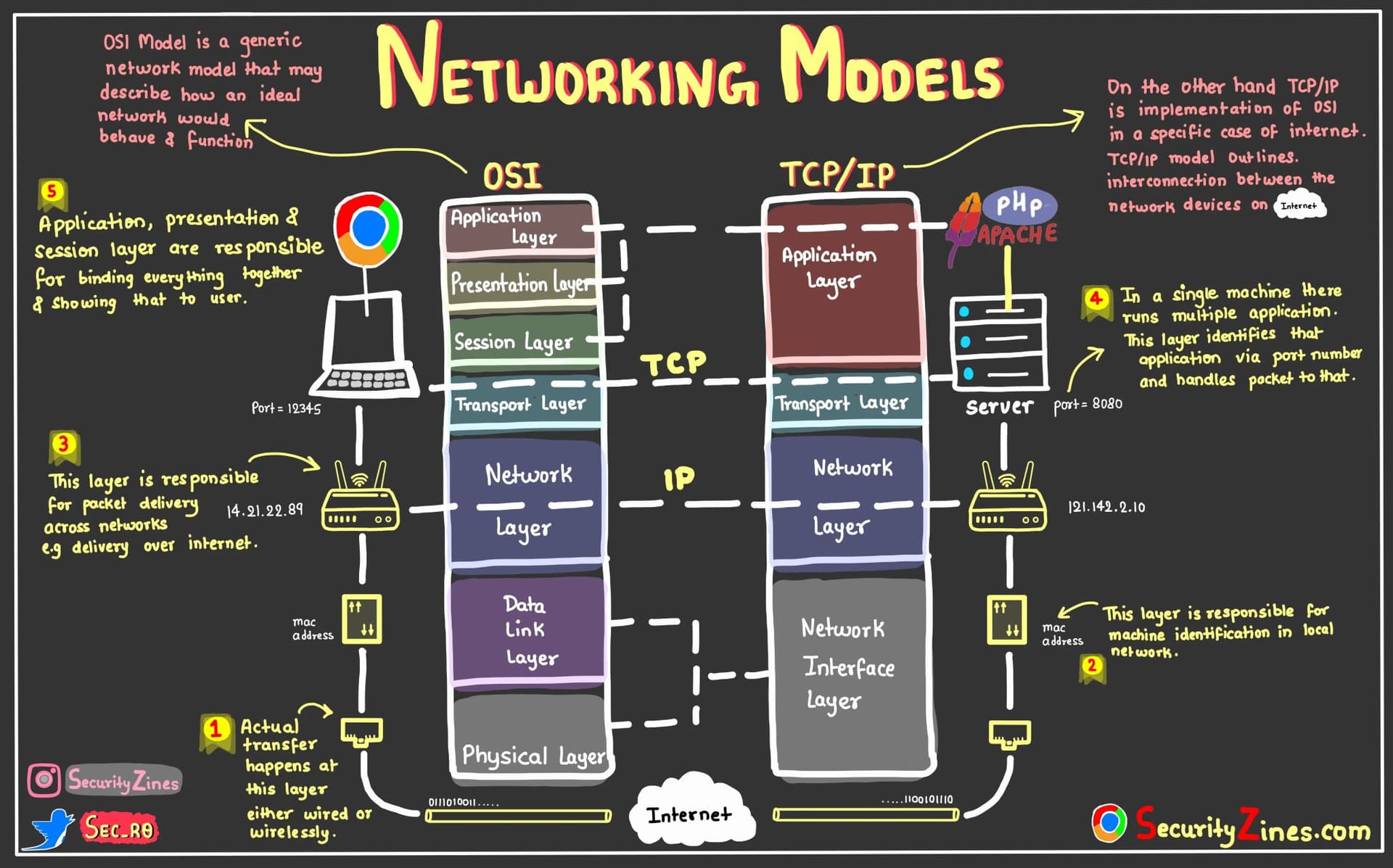
As data is sent, it passes down through the layers. As data is received, it passes back up through the layers. Lets look at each layer from the one closest to the user.
Layer 7 Application Layer
This is the layer you actually work with. It includes the protocols that permit applications to communicate over a network, such as HTTP (web browsing), FTP (file transfers), and SMTP (email). This is the layer you are working at when you open a browser and load a website.
Layer 6: The Presentation Layer
This layer handles formatting, encryption, and compression so that data sent by one system is correctly understood by another. Basically it converts the data to a format that both sender and receiver understand . It also does some other stuff like SSL/TLS encryption .
Layer 5: Session Layer
It is responsible for the establishment, management and closure of communication sessions between two devices. It keeps track of whose turn it is to send data. It keeps sessions in sync, which is very important for things like video calls and long file transfers.
Layer 4: Transport Layer
This is where the data is reliably delivered. TCP and UDP are live protocols here. TCP ensures data arrives in the right order, but UDP sacrifices this guarantee for speed, which is why it’s used for live streaming and online gaming.
Layer 3 Network Layer
The Network Layer takes care of logical addressing and routing . It finds the best path for data to travel through multiple networks . It is responsible for getting data from one network to another . At this layer IP addresses and routers are used .
Layer 2: Data Link Layer
This layer is responsible for formatting data for transmission, and detecting errors, between two directly connected devices. MAC addresses and switches are found here and this layer is also where Ethernet frames are created.
Layer 1: The Physical Layer
Here’s the groundwork: real cables, network adapters, radio frequencies, electrical signals. This is simply the transmission of bits, ones and zeroes, over a physical medium.
Remembering the Layers of the OSI Model
Most students use a mnemonic to cement the order in memory. One popular one going down from Layer 7 to Layer 1 is:
“All People Seem To Need Data Processing”
- All = Application
- People = Presentation
- seem = session
- To = Transport
- Need = Network
- DataLink = Data
- Processing = Physical
Choose your own poison or make your own. Whatever floats your boat. The exact wording of the mnemonic is much less important than the order.
OSI Model vs TCP/IP Model: Significant Differences
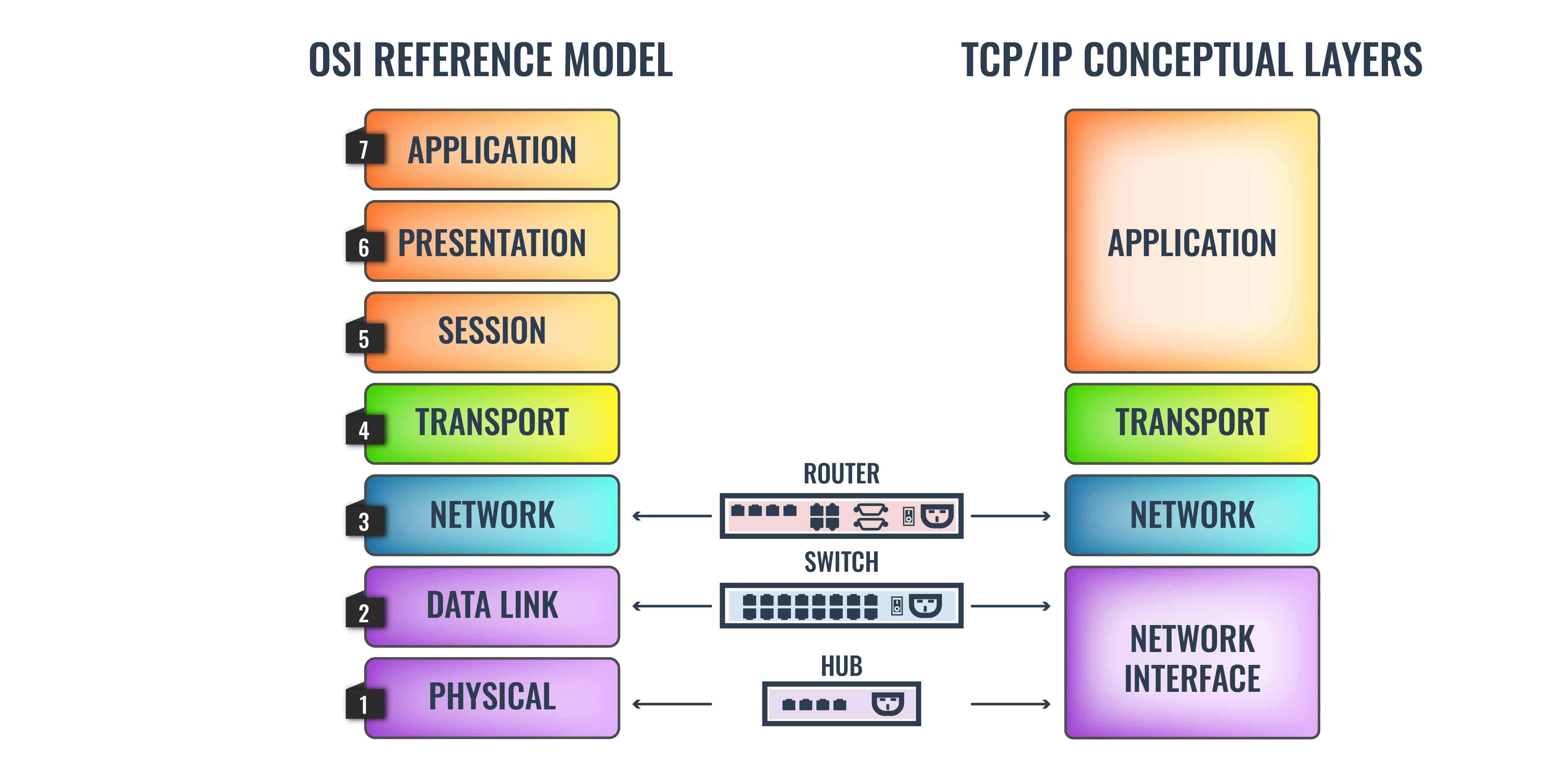
A lot of beginners get confused between these two so here is a clear side by side comparison.
| Factor | TCP/IP Model | This Framework |
|---|---|---|
| Number of layers | 4 layers | 7 layers |
| Origin | ISO theoretical standard development | Developed by the U.S. Department of Defense, based on actual protocols |
| Usage | Instruction and Troubleshooting Guide | What real-world networks actually run |
| Application, Presentation, Session | Equivalent to Layer 7-5 Combined into a single Application layer | |
| Equivalent to Layer 4 | Transport Transportation | |
| Equivalent of Layer 3 | Network Internet | |
| Layer 2-1 equivalent | Data Link, Physical Combined into one Network Access layer |
Real World Examples of OSI Model
Knowing the layers in theory is one thing. Here’s how it looks in real life:
- Load a web page: Your browser (Layer 7) requests a page, TLS encryption is applied (Layer 6), a session is opened with the server (Layer 5), TCP splits the data into segments (Layer 4), your router finds the path using IP addressing (Layer 3), your network card formats the frames (Layer 2), and the signal travels over your cable or Wi-Fi (Layer 1).
- Sending an email – SMTP is the actual sending (top layer), but the same lower layers work behind the scenes to physically move the message to the mail server.
- Video calls: UDP at the transport layer puts speed ahead of perfect delivery, so calls glitch rather than freeze completely when the network gets congested.
Common Mistakes When Studying OSI Model

- Recollection without understanding. But knowing the mnemonic is useless unless you can explain what each layer does.
- Playing around with TCP/IP model. They are similar but not identical and certification exams often test the differences directly.
- Lack of practical application. It’s much easier to remember this framework if you think of it in terms of real troubleshooting situations instead of an abstract list.
- Skipping hands-on experience. You can only get so far reading about the layers. The concept really clicks when you use tools like wireshark and you can actually see traffic moving through these layers.
Want to develop these skills yourself?
Reading about the OSI Model is a great start, but understanding how it plays out in real routers and switches and live network traffic is what actually prepares you for a networking career . This framework is taught in detail in our CCNA course at Pentest Craft with practical labs on routing, switching and troubleshooting with live Cisco environment.
If you want to take it further, our CCNP course will build on these basics to cover more advanced enterprise networking. We also have our HCIA-Datacom and HCIP-Datacom programs for those interested in Huawei networking technologies.
Explore our entire catalog of courses and start turning theory into practical, job-ready skills, whether you are just starting your networking career or preparing for a certification exam.
FAQ
Why does the OSI Model have 7 layers and not the 4 layers in TCP/IP?
This was developed as a detailed theoretical reference, with the responsibilities divided into more specific categories. The TCP/IP model was developed around the actual protocols already in use, and combines some of those responsibilities into fewer layers.
At which layer of OSI Model does firewall work?
Traditional firewalls are typically Layer 3 and Layer 4, filtering traffic based on IP addresses and ports. Modern next-generation firewalls are able to inspect traffic up at Layer 7, enabling more granular application-level filtering.
What about the OSI Model in today’s real networks?
Real networks are built on the TCP/IP model but the framework is still the main teaching and troubleshooting reference used in the industry because of how cleanly it separates each function.
How do you remember the OSI Model layers?
The most common way is a mnemonic such as “All People Seem To Need Data Processing,” but the concept will stick far better when combined with hands-on practice with tools such as Wireshark.
Do I need to know the OSI Model for the CCNA?
Yes. This is one of the core topics on the CCNA exam, and you will see it both directly (in questions that target this topic specifically) and indirectly (in questions about particular layers, protocols, or devices).
Final Thoughts
The OSI Model is not some exam topic you memorise and forget. It is the common language that network engineers across the world use every day to design, explain and troubleshoot how data really moves. When it truly clicks you’ll begin to see it everywhere, in every packet capture, every troubleshooting conversation you have, and every certification exam you’ll take.
Learn the layers and relate them to real world examples and practice hands on whenever you can. That combination is what makes this framework something you know, and not just something you’ve memorized.