Computer Network Types LAN, WAN, MAN & Others Demystified
If you are studying IT, preparing for a CCNA exam or just trying to understand how the internet actually connects your laptop to a server half way across the world, you have probably heard the term “network” a hundred times without a clear picture of what it means. This guide simplifies the major types of computer networks and explains them in plain language so that you walk away knowing exactly what a LAN, WAN, MAN and a few other network types are – and when each one is actually used.
What is a network computer?
A computer network is simply a group of two or more devices – computers, servers, printers, phones – that are interconnected so they can share data and resources. The connection can be a physical cable or a wireless signal, and it can be between one room or an entire continent.
There are many different types of computer networks because “connecting devices” can mean very different things depending on the distance involved, the number of users, and the purpose. Both a home Wi-Fi setup and the network that runs a bank’s ATM system are networks, but they are built and maintained in very different ways.
Why Knowing the Different Types of Computer Networks is Important

Knowing about the different types of computer networks isn’t just exam trivia — it’s the foundation of nearly every IT career path, from network administration to cybersecurity to cloud engineering. Certifications such as CCNA and CCNP directly test this knowledge, as every troubleshooting decision, every security policy, and every infrastructure design starts with knowing what kind of network you have.
Main Types of Computer Networks
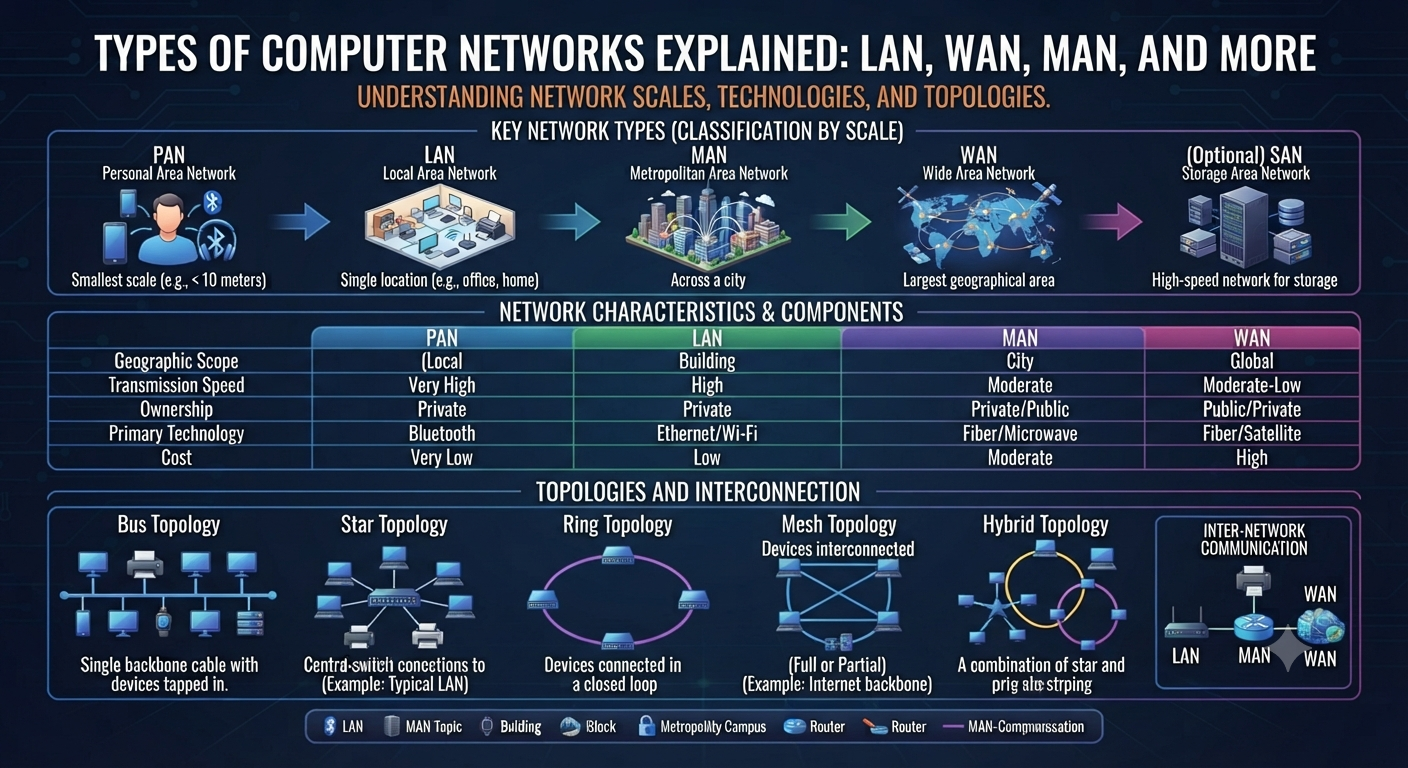
Geographic size is the easiest way to understand the different types of computer networks, and computer networks are usually classified by geographic size. This is what you will most often see, from smallest to largest.
Local Area Network (LAN)
A LAN is a network confined to a small physical space such as a single office, a home, a school lab, or one floor of a building. This is the most common of all the types of computer networks, as almost every home and business has one.
A LAN is a network owned and operated by one company or person, and it typically uses Wi-Fi or Ethernet connections. Because the devices are close together, such as sharing files between office computers or connecting to a local printer, LANs have very high speed and low latency. To set up a network you will typically need a router, a switch, and network cabling or a wireless access point.
WAN Wide Area Network
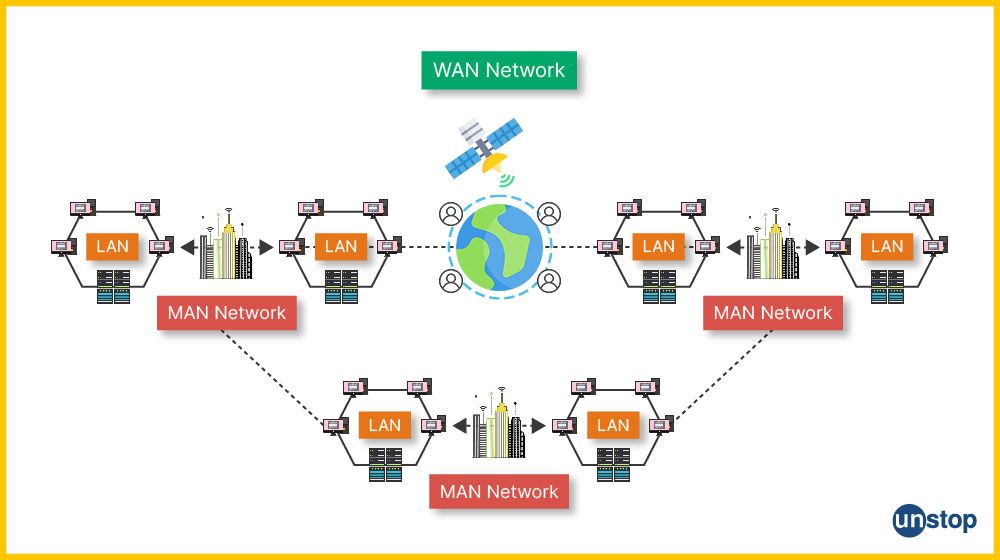
A WAN connects devices over large geographical areas such as cities, countries, or continents. The biggest example of this type of network is the internet itself, but private companies also build their own wide area networks (WANs) to connect branch offices in different locations.
Unlike a LAN, a WAN typically uses third-party infrastructure such as leased telecom lines, satellite links, or fiber-optic backbones since no single organization owns the cables stretching across entire countries. Speed and latency vary greatly depending on the type of connection. WANs also require more complex routing, security and management than a LAN. Of all computer network types, WANs are the type that enables remote work and worldwide business operations.
MAN (Metropolitan Area Network)
A MAN is somewhere in between a LAN and a WAN – it covers a city or a large campus, interconnecting multiple LANs in that area. City governments, multi-campus universities, and cable TV providers often use MANs to connect buildings without relying on the entire public internet.
MANs are usually owned by one organization or an Internet service provider that provides metropolitan coverage. MANs use high speed fiber optic connections. It is not a very known member of the family of network types, but it has an important role in the urban infrastructure.
PAN (Personal Area Network)

PANs are the smallest network, centering on a single person’s immediate devices — say, a phone and wireless earbuds, a smartwatch or a laptop connected over Bluetooth. Its range is usually only a few meters.
Most modern scenarios have PANs that are wireless by default and is used all the time without people knowing that it is technically a network.
CAN (Campus Area Network)
A CAN links together many LANs over a small geographical area, such as a university or corporate campus, but not across a city like a MAN. It’s basically a bridge between LAN scale and MAN scale. It’s common for educational institutions where several buildings need to share resources like a central server or library database.
SAN (Storage Area Network) *
A SAN is a high-speed, special-purpose network that connects servers to storage devices that is independent of the normal data network. SANs are used by businesses for centrally storing data, backups and disaster recovery because they deliver fast access to data at the block level without slowing down the main network.
WLAN (Wireless Local Area Networking)
A WLAN is just a LAN that connects devices using wireless technology (Wi-Fi) instead of physical cables. The convenience of not having to run cables to each device has made the setup the default in homes, cafes and offices, although it usually sacrifices a bit of speed and security compared to a wired LAN.
Difference Between LAN and WAN and MAN
| Feature | LAN | MAN | WAN |
|---|---|---|---|
| Coverage area | Single building/room | City-wide | Country/global |
| Ownership | One organization | Single entity and/or ISP | Several providers |
| Speed | Very fast | Fast | Varies (often slower) |
| Setup cost | Low | Medium | High |
| Example | Office network | City gov network | The net |
Seeing these three types of networks together makes it easier to understand why organizations use different types of networks depending on how far their data needs to travel.
Computer Network Types by Architecture
Besides geographical classification, network types can also be classified by the way devices communicate with each other:
Client-Server Network: Clients request resources from a central server. Most business networks including LAN and WAN use this model as it is easier to manage security, backups and access control from one central location.
Peer-to-peer (P2P) network: All devices are equal and can share resources directly with any other device, without a central server. This model is common in small home networks and file-sharing systems, but becomes more difficult to secure and manage as the number of devices increases.
How to Choose the Right Type of Network
The choice among the different types of computer networks depends on three questions: how far apart are the devices, how many users need access, and what is the budget for infrastructure and maintenance? A small office with ten employees will only need a LAN. A company with presence in five cities needs a WAN” A MAN could be used for a university spread over one city. By matching the network type to the actual use case, you avoid overspending on infrastructure you don’t need – or under-building a network that can’t scale.
Get Hands-On Pentest Craft Networking Experience
Reading about the different types of computer networks is a good start but hands-on practice with real routers, switches and enterprise-grade network labs gives you real, job-ready skills. In our Networking track at Pentest Craft which includes CCNA, CCNP, HCIA-Datacom and HCIP-Datacom courses, you will be guided by instructors with practical industry experience to design, configure and troubleshoot all types of networks covered in this article. If you are serious about a career in networking or cyber security, this is where the theory turns into a usable skill on the job.
Computer Networks Types FAQs
1. What are the different types of computer networks?
LAN (Local Area Network), WAN (Wide Area Network), MAN (Metropolitan Area Network), PAN (Personal Area Network), CAN (Campus Area Network), SAN (Storage Area Network) and WLAN (Wireless LAN) are the most taught types of computer networks.
2. LAN and WAN: what is the difference?
A LAN connects computers in a small area, such as a single building, and is owned by one organization. A WAN connects computers over large distances, often across cities or countries, and usually uses third-party infrastructure to connect.
3. Is the internet a WAN?
Yes, the internet is the largest and most famous WAN in existence, connecting millions of smaller networks around the globe.
4. Which is the most secure computer network?
Generally LANs are easier to secure since they are in one physical location and under the management of a single team. WANs require layered security unlike a LAN because data travels over a public and third-party infrastructure.
5. What is the difference between MAN and CAN?
A MAN spans a whole city or metropolitan area, often linking several organizations . A CAN is confined to a single campus ( e.g. a university ) . Typically , a CAN is owned by a single organization .
6. Do I have to learn all types of computer networks for CCNA certification?
Yes, the CCNA curriculum is built on understanding all major types of computer networks, especially LAN and WAN concepts, which forms the basis of more advanced networking topics like routing and switching.
Conclusions
Understanding the different types of computer networks, from a small home LAN to a global WAN, provides the foundation for almost any IT or cybersecurity job. Each type of network exists to solve a specific problem concerning distance, speed and management, and knowing which to apply to a given situation is a skill that pays off whether you are troubleshooting a home router or designing enterprise infrastructure. If you want to move from understanding these concepts to actually building and managing them, the Networking courses from Pentest Craft are designed to get you there.