
Intro: Cybersecurity Trends to Watch in 2026
The cybersecurity industry is always following the fast-changing digital world. As organizations transition to cloud-first, remote-enabled operations, the stakes have never been higher. As 2026 looms cyber criminals are using the latest technology and cyber threats are becoming more sophisticated. So what does this mean for government, business and the public? The answer is clear. It’s not an option – you must keep up with the latest cybersecurity trends. In this article, we’re going to look at the top cybersecurity trends for 2026, and share useful tips, real-world examples, and insights that can help you protect your personal data and organization in an ever-evolving threat landscape.
1. AI:

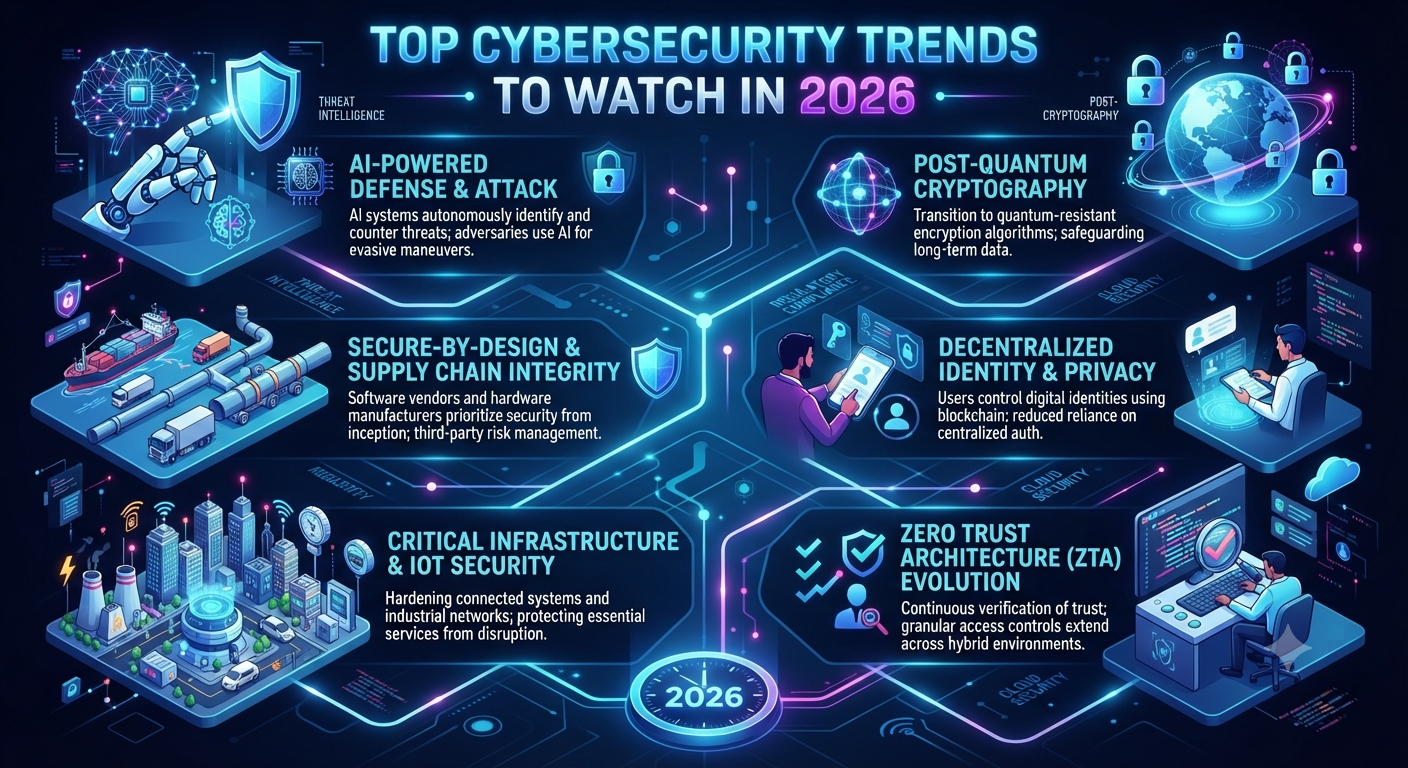
AI is changing everything in cybersecurity. On the offensive side, AI-enabled tools can analyze vast volumes of data on the fly, identify anomalies and counter threats at an unprecedented pace. Machine learning models are excellent at detecting anomalous activity on networks, new malware, and even predicting future attacks based on behavioral analysis. AI is also being targeted by cybercriminals. More attacks will be carried out using AI, including malware that changes its form to avoid detection, deepfake scams and AI-powered phishing emails. In the face of the AI arms race, the need for skilled professionals who can outsmart human adversaries and automated threats will only grow.
2. The Evolution of Double Extortion and Ransomware
Ransomware attacks have evolved so much in the last decade and 2026 will not be different. The latest trend among criminals is to encrypt the data of their victims and threaten to publish it if the ransom isn’t paid, a practice known as “double extortion.” Schools, healthcare providers and critical infrastructure are frequent targets because the consequences can be catastrophic.
For protection against ransomware, companies should have impenetrable backups, strong endpoint protection and ongoing employee education to recognize phishing, which is the primary way most ransomware attacks start.
3. Enforce Zero Trust Security

Traditional perimeter-based security paradigm, which assumes all nodes inside the network are trusted, is dying out fast. #1 — Zero Trust Will Become the De Facto Standard by 2026. Zero Trust assumes, by default, that no user, device or application should be trusted regardless of their location.
Organizations are trending toward continuous authentication, micro-segmentation, tight access controls and real-time monitoring of user behavior. This approach mitigates the impact of a breach and limits the lateral movement of adversaries.
4. Cloud Security Complexity
As organizations deploy more cloud applications and sensitive data, the complexity of securing cloud environments is growing. Supporting hybrid and multi-cloud environments is now standard practice, so you need security policies and visibility across AWS, Azure, Google Cloud and private clouds.
Misconfigurations remain the number one cause of cloud breaches, with data leaks via public storage buckets and over-permissions still the most common. Expect automated configuration checks, Cloud Security Posture Management (CSPM) tools and “shift-left” security — embedding security early in the development lifecycle — to become commonplace in 2026.
5. Rise of Supply Chain Attacks

Consequently, cybercriminals are increasingly exploiting vulnerabilities in third-party software, hardware and service providers. “The Kaseya and SolarWinds attacks both show how the compromise of a single vendor can impact thousands of downstream organizations.
To mitigate the risk, organizations are demanding transparency and tracking software updates for suspicious patterns and performing detailed vendor assessments to mitigate the risk.
6. Data Sovereignty and Privacy Legislation

High-profile data breaches have been widely publicized and governments around the world are implementing stricter privacy laws. By 2026, it is expected that more countries will adopt GDPR-like regulations, which include data protection, breach notification, and data sovereignty (i.e., keeping data within certain geographical boundaries).
Compliance is more than a checkbox; it is a competitive advantage. By implementing privacy by design, organizations can build trust with their customers and avoid costly penalties.
7. Scaled Security for the Internet of Things (IoT)
The proliferation of IoT devices, including industrial sensors, medical devices and smart home gadgets have opened up a vast attack surface. By 2026, billions of connected devices will be online. A significant number of them will lack even basic security controls.
We expect an increase in assaults on susceptible IoT endpoints either to initiate Distributed Denial-of-Service (DDoS) attacks or to access network infrastructure that is significantly larger. Organizations will need to segment IoT devices and continuously monitor them. Manufacturers will face more pressure to adopt security standards.
8. Biometric Authentication and No Password

But passwords remain susceptible to human error from phishing and credential stuffing attacks. Passwordless Authentication: By 2026, more organizations will adopt passwordless authentication, using biometrics (fingerprint or facial recognition), security keys, and mobile push notifications. Biometric authentication can reduce risk and friction, but also raises new privacy concerns and attack vectors. “It will be important to have a multi-layer approach that combines biometrics with other factors.
9. Security orchestration and automation (SOA)
The need for automation is driven by the ever changing nature of cyber threats and a lack of skilled security professionals. Security Orchestration, Automation and Response (SOAR) platforms can help streamline the detection, investigation and response processes. Teams can triage alerts, contain threats and remediate incidents in the moment. By 2026, automation will be used more for accomplishing routine work, leaving human analysts to focus on sophisticated threats and higher-level decision making.
10. Quantum Computing and Post-Quantum Security

Quantum computing is a revolution in the technology that can revolutionize the field of computing but can also endanger the security of many existing encryption schemes. Even though large-scale quantum attacks have not yet happened, forward-looking organizations are getting ready for a post-quantum world by evaluating their cryptographic assets and exploring quantum-resistant cryptography.
“Technology is moving so fast, but you still have to be competitive in the data security space.
To sum up, the cybersecurity landscape of 2026 will be characterized by the ever-evolving regulatory environment and rapid technological advancement. Both attackers and defenders will be powered by artificial intelligence. Ransomware will become more sophisticated. The explosion of connected devices, privacy regulations and supply chain risks necessitates new strategies and a constant state of vigilance.
You need Zero Trust, automation, train people and be able to adapt to change to survive and thrive. At the end of the day, cybersecurity isn’t just IT. It’s a fundamental ingredient of success in the digital age, a trust enabler and a business imperative.
Make sure to include cybersecurity in your 2026 and beyond plan to stay aware and forward-looking.