Ethical Hacking – What Is It? Introduction to White Hat Hacking

Most people when they hear the word “hacker” think of someone breaking into systems from a dark room, causing damage and disappearing into thin air. That picture is not wholly inaccurate, but it is only part of the story. The other half is ethical hacking. These are the skilled professionals who hack into systems intentionally, with permission, to find weaknesses before the criminals do.
This guide covers what ethical hacking really is, how it differs from illegal hacking, what ethical hackers do day-to-day, and what it takes to get started in this field — whether you’re completely new to cybersecurity or just trying to understand the term properly for the first time.
What is Ethical Hacking Actually?
Ethical hacking is an authorized attempt to gain access to computer systems, networks, or applications to find potential vulnerabilities that a malicious hacker could exploit. The key word here is authorized – ethical hacking is only performed with the express permission of the owner of the system, under clearly defined rules and boundaries.
Ethical hackers employ many of the same tools and techniques as criminal hackers, but the intent and legality are entirely different. While a malicious hacker breaks in to steal data, cause damage or extort a business, an ethical hacker does the same technical work to report vulnerabilities so they can be fixed. This is also why ethical hacking is sometimes called “white hat hacking.” A reference to old westerns where the good guys wore white hats and the bad guys black.
Why is Ethical Hacking Necessary?

Any organization that stores data, runs a network, or operates online systems is at risk. Attackers are constantly seeking out vulnerabilities: old software, weak passwords, badly configured servers, unpatched vulnerabilities. On the defender side, ethical hacking is there to find those same vulnerabilities before someone with bad intentions does.
That’s why ethical hacking has evolved from a niche IT skill to one of the most in-demand skills in the tech industry. Ethical hackers are routinely used by businesses, governments and even individual app developers to test their systems. The cost of a real breach, in terms of money, legal fall-out and reputation, is almost always greater than the cost of prevention.
Ethical Hacking vs Illegal Hacking: What is the Difference?
The technical skills used for ethical hacking and illegal hacking can look almost identical from the outside. And the real difference comes down to three things: permission, intent and legality.
- Permission – Ethical hackers have a signed agreement (usually called a scope of work or rules of engagement) that specifically gives them permission to perform testing. Illegal hackers do not have this authorization.
- Intent — Ethical hackers seek to discover and report weaknesses so they can be fixed. Malicious hackers want to exploit weaknesses for personal gain, disruption, or theft.
- Legality – Ethical hacking is 100% legal when done under a sanctioned contract. The vast majority of countries classify the same unauthorized acts as criminal offenses.
This is why professional ethical hacking always starts with clear documentation, what systems can be tested, what methods are fair game, and what the reporting process looks like once testing is complete.
The Different Kinds of Hackers
Once you understand the broader categories hackers are usually put into, then ethical hacking is easier to understand:
- White Hat Hackers — Ethical hackers who are authorized to test systems to improve security. Ethical hacking is a part of this category.
- Black Hat Hackers – Malicious hackers who hack into systems without permission, usually to steal money, data or cause disruption.
- Gray Hat Hackers – In between; they might find and report vulnerabilities without specific permission, technically breaking rules but not with malicious intent. Professional ethical hackers steer clear of this legally risky middle ground.
Ethical hacking as a career and discipline is firmly in the white hat camp — authorization is not optional, it’s foundational to the profession.
What Is an Ethical Hacker and What Do They Do?
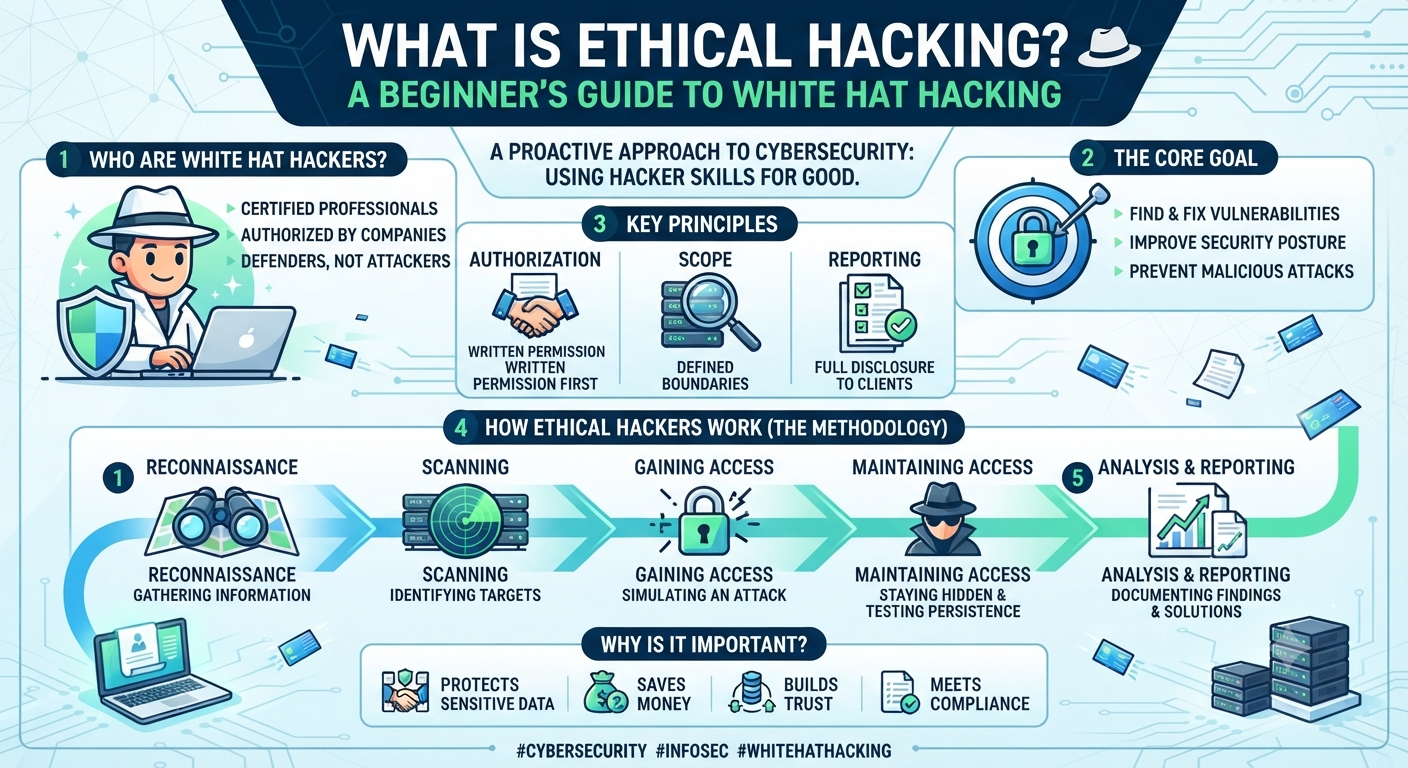
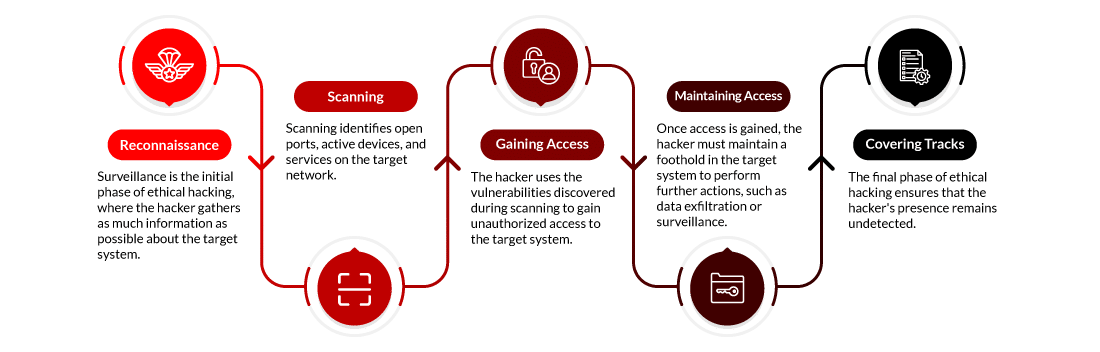
Ethical hacking work is usually done following a process on a day to day basis, rather than just randomly poking around. Most engagements proceed through phases that look something like this:
- Reconnaissance – Gathering information about the target system, such as information about the domain, network structure or any publicly available information that can be useful.
- Scanning – Using tools to find live systems, open ports, and services running on the target network, creating a map of what’s actually accessible.
- Gaining Access – Trying to exploit vulnerabilities to show how the hacker can actually get into the system, but always within the limits of the authorization agreement.
- Maintaining Access — Testing if a simulated attacker can remain undetected within a system over time, helping organizations understand real-world persistence risks.
- Reporting — Documenting every vulnerability found, how it was exploited, and clear recommendations on how to fix it. This report is often the most valuable deliverable of the entire engagement – it’s what actually makes the organization more secure afterwards.
This methodical approach is what separates professional ethical hacking from random experimentation. Each phase serves a purpose and the final report is what translates technical findings into real, actionable security improvements.
Ethical Hackers Test Common Spaces
Ethical hacking is not just for one type of system. Ethical hackers may test the following, depending on the engagement:
- Networks – Searching for weak configurations, exposed services or outdated firmware.
- Web applications – Testing for common vulnerabilities such as injection flaws, broken authentication, and insecure data handling.
- Wireless networks – Testing Wi-Fi infrastructure for encryption strength and access controls
- Physical security — Testing in some engagements whether or not unauthorized persons could physically get into secure areas.
- Social engineering – Evaluating employees’ susceptibility to being tricked into revealing confidential information, often through simulated phishing attacks.
It’s a range, and that is part of why the ethical hacking field rewards broad security knowledge, not a single narrow skill.
Skills Required to Become an Ethical Hacker
Ethical hacking demands a blend of technical and analytical skills, such as:
- Good understanding of networking basics (data movement across systems)
- Familiarity with operating systems, especially Linux, which is dominant in security tooling
- Awareness of common vulnerabilities and how they are typically exploited
- Scripting/programming knowledge, helpful when automating tasks and understanding the logic of exploits
- Excellent documentation and communication skills, clear reporting is a core part of the job
You’ll notice the last point is one that often surprises people — ethical hacking is not purely technical. Finding a vulnerability is important, but being able to explain it clearly to a non-technical stakeholder is just as valuable.
Certifications to Build a Career in Ethical Hacking
Hands-on skill is most important, but certifications help prove what you know and are often required by employers, especially in the early stages of a career. The most well-known certification in this space is CEH (Certified Ethical Hacker) which covers the tools, techniques and methodology used in professional ethical hacking engagements.
Other certifications, such as CISSP, are more geared toward general information security management. More advanced, hands-on certifications test actual exploitation skills rather than theoretical knowledge. Many people who want to get into ethical hacking as a profession will have a basic understanding of networking and Linux before they start getting into these more specialized certifications.
Is a Career in Ethical Hacking a Good Choice?
With the growing frequency and sophistication of cyberattacks, and the increasing number of businesses that are moving vital operations online, the need for ethical hacking skills has been rising steadily. Across almost every industry, from finance and healthcare to government and retail, there is a need for people who can actively find and fix security weaknesses in organizations.
If you’re new to cybersecurity, ethical hacking is a great way to start because it is hands-on, practical, project-based and applicable to other jobs like Security Analyst, Penetration Tester, Security Engineer, etc. as you grow in your career.
Ethical Hacking FAQs
1. What is ethical hacking?
An ethical hacker is someone who tests computer systems, networks and applications with permission to find security weaknesses before malicious attackers can exploit them and then reports those findings so they can be fixed.
2. Is ethical hacking legal?
Yes, provided it has explicit, documented authorization from the system owner. The same acts would be against the law without authorization.
3. What is the difference between Ethical Hacking and Hacking?
The key difference is intent and authorization. Ethical hacking is done legally and with approval to enhance security. Hacking illegally is unauthorized hacking, often for personal gain or to cause damage.
4. Is it necessary to have a certification to be an ethical hacker?
Not strictly, but certifications like CEH are well recognized by employers and they help you prove your knowledge, especially when you are just starting out and do not have professional experience to show yet.
5. What are the skill sets of ethical hackers?
Strong understanding of networking concepts
Knowledge of Linux and security tools
Knowledge of common vulnerabilities
Scripting skills
Strong written communication skills to report findings clearly
Summary
Ethical hacking is not the dramatic Hollywood version of hacking. Rather it is a structured, authorized and genuinely valuable discipline that helps organizations discover and fix security weaknesses before real attackers can exploit them. For those new to cybersecurity, it provides a practical, in-demand career path based on real technical skill, not guesswork.
If you’re ready to transition from thinking about ethical hacking to doing it, Pentest Craft’s CEH (Certified Ethical Hacking) and Penetration Testing courses will walk you through the same methodology, tools and hands-on labs used in real-world security engagements.